• Skip to primary navigation
  • Skip to main content

HRMorning

  • FREE RESOURCES
  • PREMIUM CONTENT
  • HR DEEP DIVES
  • PODCASTS
    • VOICES OF HR
    • WOMEN’S LEADERSHIP TODAY
  • LOGIN
  • SIGN UP FREE
  • Employment Law
  • Benefits
  • Recruiting
  • HR Technology
  • Payroll
  • Management
  • Women’s Leadership
  • More
    • Talent Management
    • Performance Management
    • Leadership & Strategy
    • Compensation
    • Policy & Procedures
    • Wellness
    • Staff Departure
    • HR Career & Self-Care
    • Health Care
    • Retirement Plans
  • Leadership & Strategy

How to Navigate the Death of a Colleague: 4 Important Strategies

Anna Griffin, HR Expert Contributor
By: Anna Griffin, HR Expert Contributor
  • Share on

About the Author

Anna Griffin, Inc. is an internationally known, high-end gift, stationery, and craft brand located in Atlanta, Georgia. For more than three decades, Founder and CEO Anna Griffin has woven creativity, connection, and beauty into the fabric of people's lives. To learn more, please visit https://annagriffin.com/

Show Less
Last Updated: July 17, 2026
5 minute engagement
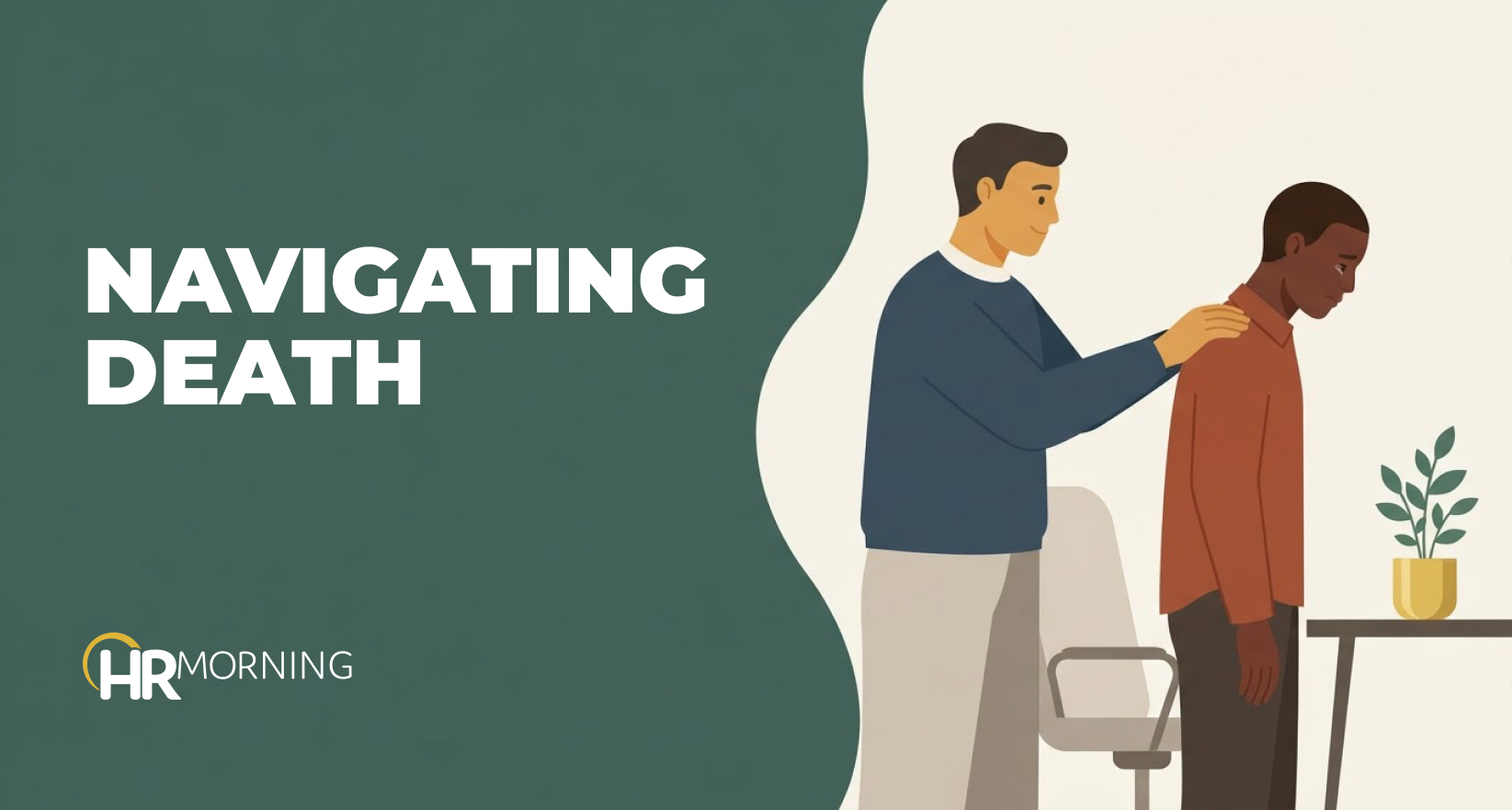
A manager comforts a grieving employee beside an empty desk, illustrating workplace support after a colleague's death

Why does it feel so taboo to talk about death? It’s one of the only certainties in life, yet conversations about death, especially in the workplace, remain some of the hardest we’ll ever have.

Maybe it’s because we don’t want to negatively impact the company culture that we’ve worked so hard to create. Or we’re afraid that talking about the deceased will cause further pain instead of easing it.

Why We Tiptoe around Death in the Workplace

In the workplace, we have a tendency to tiptoe around certain conversations, including death. It’s not because we don’t care but because we feel poorly equipped to navigate the conversation with the grace it deserves. Most companies are designed to keep things moving forward, and death interrupts that. When we lose a member of our team, it leaves no room for avoidance. And there’s no playbook on how best to respond.

I’ve struggled with this myself. In the last few months, loss has touched my company in ways I never could have anticipated: My team unexpectedly lost our CFO, along with three members of our broader Anna Griffin, Inc. community.

Each loss left its own mark on our team, and I quickly realized that there was so much more I could be doing to make support after death a part of my company culture, especially when it comes to losing a team member.

What Support Can Look Like

The way we handle the death of an employee sets the tone for the rest of our team. It’s a lot of responsibility, but also an opportunity to cultivate a culture of genuine empathy.

From my experience, here are a few things we can do to meaningfully support our teams:

Allow People to Express Their Grief

Creating a workplace culture where people feel comfortable enough to express their grief is one of the most important things you can do. Yes, that means letting people cry, as uncomfortable as it may initially feel, to witness such vulnerability.

But our team members are not just employees. They are whole people, and they show up to work as such. Grief is one of the hardest human experiences, and losing a colleague can take a huge toll on your entire team. Instead of trying to just move on, make space where people can talk openly about their grieving process and share stories about the team member you all have lost.

Consider sending a company-wide email letting your team know that you are here as a listening ear if they need someone to talk to or need to be pointed in the right direction for additional support resources. You might also offer flexible time off and remote work options, not just in the immediate but in the weeks that follow, with the understanding that grief is not a linear process.

Help Employees Transition the Workload

The reality is, even under tragic circumstances, the work doesn’t stop. It’s a delicate balance of delegating responsibilities from the deceased team member without overwhelming your staff.

The key is being realistic and flexible about performance expectations and timelines. Some team members might cope by jumping right into tasks, while others may need more time to get back into the rhythm of things. Instead of making assumptions, discuss capacity with your employees. Delegate what you can, with the option of pausing non-essential duties to avoid burnout.

Make It Personal

Beyond your team, you can extend support to your lost employee’s loved ones, too.

Sending cards and flowers to a deceased team member’s family is a wonderful gesture. But the key is making it personal. Too often, we are afraid to say the wrong thing or even talk about the departed person to avoid adding to the grief. So, we opt for the generic “I’m sorry for your loss” or, worse, say nothing at all.

Yet people who have lost a family member or friend typically welcome personal anecdotes about their life and legacy. When I’ve written to the families of team members and community members we’ve lost, I’ve made it a point to include something specific: a story about the way they lit up a room, a project they poured their heart into, or a small moment that captured who they really were.

One of the most powerful things you can tell a grieving family is something they didn’t already know, like the way their loved one mentored a newer colleague or the joke they told every Monday morning that became a workplace tradition. These details are gifts. They tell a family that their person mattered here, that they were valued not just for their work, but for who they were.

For smaller, closely knit teams, these stories come naturally. For larger companies, it may take a bit more effort to find. But it’s well worth your time to gather stories from your colleagues, as a heartfelt card will be treasured in ways that a standard sympathy note won’t be.

Try to Lessen the Load

Death can make life so complicated for the people who are left behind. But as an employer, you have a unique place to be proactive and help lessen the load.

When it comes to employee benefits, you might consider adding funeral cost coverage to the equation. Or, from the planning perspective, you might give your team members the option to have their last wishes added to formal insurance documents, so it’s one less thing their loved ones have to worry about in the case of their death.

I’m also a big fan of acts of kindness, so depending on the size and dynamic of your team, you can think of creative ways to come together to provide support to the family after the passing. That might be volunteering time to help with day-to-day responsibilities like meals, which can quickly get overwhelming in the middle of grief. Whatever you decide on, you can create a simple, opt-in way for employees to contribute without placing pressure on anyone or overwhelming loved ones with outreach.

There’s nothing easy about losing a team member. But by building a culture where grief is handled with honesty and grace, you create the kind of trust that carries your team through the hardest moments. That is the kind of workplace people never forget.

Filed under
  • Leadership & Strategy
  • Share on

Get the HRMorning Newsletter

With HRMorning arriving in your inbox, you will never miss critical stories on labor laws, benefits, retention and onboarding strategies.

  • This field is for validation purposes and should be left unchanged.
  • This field is hidden when viewing the form
  • This field is hidden when viewing the form
  • This field is hidden when viewing the form
  • This field is hidden when viewing the form
  • This field is hidden when viewing the form
  • This field is hidden when viewing the form
  • This field is hidden when viewing the form
  • This field is hidden when viewing the form
  • This field is hidden when viewing the form
  • This field is hidden when viewing the form
  • This field is hidden when viewing the form
  • This field is hidden when viewing the form
  • This field is hidden when viewing the form
  • This field is hidden when viewing the form
  • This field is hidden when viewing the form
  • This field is hidden when viewing the form
  • This field is hidden when viewing the form
  • This field is hidden when viewing the form
  • This field is hidden when viewing the form
  • This field is hidden when viewing the form
  • This field is hidden when viewing the form
  • This field is hidden when viewing the form
  • This field is hidden when viewing the form
  • This field is hidden when viewing the form
  • This field is hidden when viewing the form
  • This field is hidden when viewing the form
  • This field is hidden when viewing the form
  • This field is hidden when viewing the form
  • This field is hidden when viewing the form
  • This field is hidden when viewing the form
  • This field is hidden when viewing the form
  • This field is hidden when viewing the form
  • This field is hidden when viewing the form
  • This field is hidden when viewing the form
  • This field is hidden when viewing the form
  • This field is hidden when viewing the form
  • This field is hidden when viewing the form
  • This field is hidden when viewing the form
  • This field is hidden when viewing the form
  • This field is hidden when viewing the form
  • This field is hidden when viewing the form
  • This field is hidden when viewing the form
  • This field is hidden when viewing the form
  • This field is hidden when viewing the form
  • This field is hidden when viewing the form
  • This field is hidden when viewing the form
  • This field is hidden when viewing the form
  • This field is hidden when viewing the form
  • This field is hidden when viewing the form
  • This field is hidden when viewing the form
  • This field is hidden when viewing the form
  • This field is hidden when viewing the form
  • This field is hidden when viewing the form
  • This field is hidden when viewing the form
  • This field is hidden when viewing the form
  • This field is hidden when viewing the form

Free Training & Resources

Webinars

Financial Wellness Benefits for a Modern and Diverse Workforce

Webinars

Gwyneth Paltrow on Challenging, Motivating and Inspiring Your Employees

White Papers

Seamless & Secure: Safeguarding the Member Experience

Provided by HealthEquity

White Papers

MODERNIZING LEGACY APPLICATIONS: WHEN, WHY, AND HOW

Provided by CHAMPS

SPONSORED CONTENT

HR Technology

sponsored content
The Best AI Software for HR Automation

Courtesy of G-P

Talent Management

sponsored content
Powerful Employee Retention Strategies for 2025: How to Keep Your Best People

Courtesy of PEOPLEGURU

Benefits

Health Care

Wellness

sponsored content
Proven Results: 5 Ways Teladoc Health Chronic Condition Management Transforms HR Outcomes

Courtesy of TELADOC HEALTH

Further Reading

  • Leadership & Strategy
Close the disability employment gap with registered apprenticeship

The American with Disabilities Act (ADA) was a monumental legislation, but there is still a great deal of work to be done to close the disa...

  • Leadership & Strategy
HR Outsourcing an Ally for Overwhelmed Departments of 1

When someone says “HR outsourcing,” your immediate reaction might be panic because the future of your job is in doubt. Not so, ...

  • Leadership & Strategy
How leaders can learn to be empathetic: An ideal in today’s workplace

Whether some leaders like it or not, their employees want them to be more empathetic. A recent survey of employees by Ernst & Young fou...

  • Leadership & Strategy
How to make a culture change in the workplace

When Deloitte interviewed over 7,000 CEOs and HR leaders, 82% of respondents said they believed company culture could provide a competitive...

  • HR Technology
  • Leadership & Strategy
Choosing the Right Workforce Management Software: 8 Priorities for HR Leaders

Buyer’s remorse is common in HR tech. According to a recent Capterra tech trends report, HR software ranks third among all B2B softwa...

  • Leadership & Strategy
Workers Don’t Trust HR: 4 Keys to Improved Relationships

Despite HR’s pivotal role in business, recent research has found that a substantial number of employees do not trust HR. Some figu...

Get the latest from HRMorning in your inbox PLUS immediately access 10 FREE HR guides.

I WANT MY FREE GUIDES
HR Morning Logo
  • Facebook
  • Linked In
  • ABOUT HRMORNING
  • ADVERTISE WITH US
  • WRITE FOR US
  • CONTACT
  • Employment Law
  • Benefits
  • Recruiting
  • Talent Management
  • Performance Management
  • HR Technology
  • Leadership & Strategy
  • Compensation
  • Policy & Procedures
  • Wellness
  • Staff Departure
  • HR Career & Self-Care
  • Health Care
  • Retirement Plans
  • DEI

HRMorning, part of the Rover Insights Network, provides the latest HR and employment law news for HR professionals in the trenches of small-to-medium-sized businesses. Rather than simply regurgitating the day's headlines, HRMorning delivers actionable insights, helping HR execs understand what HR trends mean to their business.

Powered By Rover Insights
Privacy Policy | Terms of Service
Copyright© 2026 Rover Insights
HRMorning Logo

WELCOME BACK!

Enter your username and password below to log in

Forget Your Username or Password?

Reset Password

Lost your password? Please enter your username or email address. You will receive a link to create a new password via email.

Log In

Why do we need your credit card for a free trial?

We ask for your credit card to allow your subscription to continue should you decide to keep your membership beyond the free trial period.  This prevents any interruption of content access.

Your card will not be charged at any point during your 21 day free trial
and you may cancel at any time during your free trial.

During your free trial, you can cancel at any time with a single click on your “Account” page.  It’s that easy.