

12 Things Smart Managers Never Say When Things Get Heated
By
Say the wrong thing in a heated conversation, and it’ll likely combust.
That’s why smart managers want to avoid things that add fuel to the fire.
And they get lots of practice because it’s nearly impossible to avoid heated situations in the workplace. About 95% of employees have to deal with conflict at work — and more than 40% say it happens frequently, according to The Workplace Peace Institute’s State of Conflict in the Workplace report.
Understanding our own conflict-handling style and personality type can help people navigate conflict more effectively.
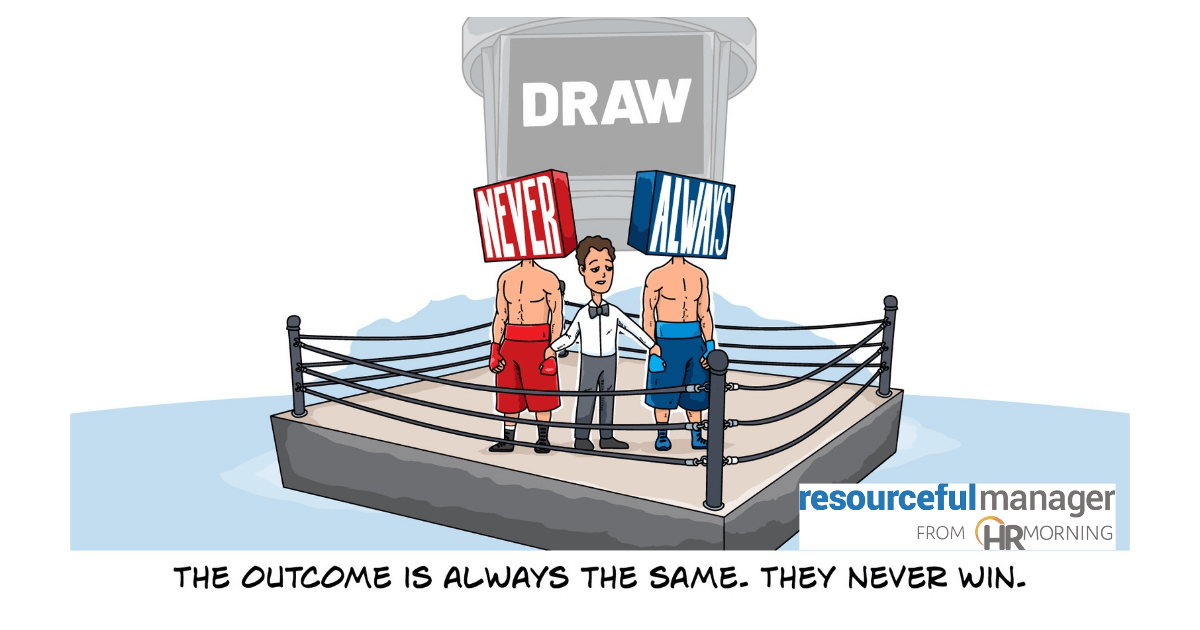
Smart Managers Never Say ‘Never’
Even when things have settled or smoothed over, people often walk away from heated conversations rehashing what was said, what they heard and how that made them feel — and the wrong words make employees and colleagues feel worse for longer.
So, while we can’t promise the worst of a conflict won’t get the best of you, we can help you recognize what smart managers never say in the heat of conflict.
Here are 12 things to avoid when things get heated, why and a healthier way to respond.
1. ‘You Never …’
Example: “You never listen to me or anyone.”
Problem: “Never” is an extreme. And if you say it, others will automatically counter with resentment and proof of when it wasn’t true.
Better: “When you do X, I feel Y.”
2. ‘You Always …’
Example: “You always blame co-workers for your mistakes.”
Problem: On the other end of the spectrum, “always” is an extreme that doesn’t likely exist and will get the same negative effects of “never.”
Better: “In the past three weeks, I see you’ve had 11 mistakes on your reports, and you just told me James was responsible for most of them. Please explain how that’s possible.”
3. ‘You’re Being …’
Example: “You’re being unreasonable.”
Problem: No one wants to be judged, especially in the midst of a heated situation. You want to avoid analyzing or calling out others’ reactions and/or behaviors.
Better: “I feel like you aren’t hearing the point I’m trying to make. How can I clarify it for you?”
4. ‘You’re An …’
Example: “You’re an idiot.”
Problem: Pegging someone with a negative — such as idiot, stupid, dumb or smartass — is a hurtful attack on the person, not just a critique of behaviors.
Better: “We’ll need to review the number of times you fell short on quality to determine what to do next.”
5. ‘I Don’t Care …’
Example: “I don’t care what you think.”
Problem: Everyone has an opinion, and in a heated situation, you almost always need to let others express theirs so they feel heard and respected. Without that, you’ll create more resentment.
Better: “I’ll listen to you. Then I’d like to share my view.”
6. ‘You’re Wrong’
Example: “You’re wrong about that.”
Problem: Trying to point fingers when something needs to be resolved won’t help you reach a solution.
Better: “Let’s focus on the facts we know to get this resolved.”
7. ‘I’m Right’
Example: “I’m right about this.”
Problem: Similar to placing blame, self-proclaimed credit won’t help you reach a resolution.
Better: “Let’s compare what we know to be facts, so we can formulate a solution based on what we agree on.”
8. ‘Calm Down’
Example: “Please calm down.”
Advertisement
Problem: This almost always has the exact opposite effect of what you’re trying to achieve. People will either become defensive because they don’t think they’re uncalm, or they’ll become more riled up because you’ve called extra attention to it.
Better: “I’m feeling a little tense about this conversation right now. Can we take a break to think things through before we talk more?”
9. ‘Can You Just …’
Example: “Can you just get over it?”
Problem: This minimizes what the other person is feeling and/or experiencing. Although you might want or need to move it along, you can’t lessen what’s real to others involved.
Better: “Let’s explore some ways to resolve this now and how we can start moving forward.”
10. ‘I Don’t Need To …’
Example: “I don’t need to explain myself to you.”
Problem: In conflict, everyone — and especially leaders — should explain reasons behind actions or decisions.
Better: “When I decided X, these three things weighed heaviest on the decision …”
11. ‘You’re Acting Just Like …’
Example: “You’re acting just like Julia did before she got suspended.”
Problem: For one, no one likes to be compared to others, especially when it’s someone they don’t see in a positive light. Secondly, employees are individuals, and you’ll want to handle every person and situation individually.
Better: “We have to discuss what’s happened here and what we can do to avoid it in the future.”
12. ‘I’m Done …’
Example: “I’m done with you/this conversation/dealing with this.”
Problem: Smart managers don’t walk out on heated conversations or difficult situations. That prevents a resolution and causes tension to linger.
Better: “I feel like we’ve gotten off track. Let’s go back and find our common ground and work from there.”
Further Reading
70+ U.S. Companies Affected by Remote Worker Fraud: FBI Issues New Guidance
You’ve reviewed an applicant’s resume and conducted an interview. But how can you be sure the remote worker you’re planning to bring onto your payroll is who they claim to be? More hiring managers are finding out that a candidate who looks great on paper and interviews well may still be an impostor. In a […]
Post-Election Fallout: 2 Ways to Manage New Tension in the Workplace
With the midterms over, you’d probably like to put the occasional (or frequent?) contentious moments any election can cause behind you. But it’s not likely to end with the last vote cast. HR and other leaders often face a recurring challenge in post-election times: acknowledging and managing politically charged moments that can turn up tension […]
An ‘Insecurity Tax’ Could Hurt Retention: 4 Solutions to Keep Your Talent
The last decade of corporate churn might have revealed this surprising lesson: One of the biggest threats to retention isn’t compensation, remote work or even AI. It could be managerial insecurity. When leadership is rooted in a manager’s personal anxiety, organizational behavior becomes entirely predictable. Micromanagement, hoarding authority, avoiding constructive dissent, and making defensive decisions […]
Politics at Work: An Election-Season Toolkit for HR Leaders
Employers everywhere are bracing for one of the trickiest challenges of the year as the country goes through another contentious election season. Inflammatory political speech in the workplace is disruptive and can lead to a host of workplace issues ranging from frustration and fractured relationships to claims of harassment and workplace violence incidents. With increasing […]
Are You Keeping Workforce Data Longer Than You Need To?
When an employee leaves, HR closes the personnel file, processes the final paycheck, and shuts off system access. Copies of that employee’s information can remain in places HR does not manage: email archives, collaboration platforms, badge-access logs, fleet telematics systems, and the files of recruiting, payroll and benefits vendors. Some of those records have to […]
How Managers Are the Missing Link in Workforce Capability: 3 Solutions
Managers are the bridge between business strategy, day-to-day execution, and organizational growth. Understanding and developing workforce capability has always been central to that role. And for HR leaders, a manager’s ability to do that well impacts everything from internal mobility and succession planning to retention and workforce readiness. The challenge is that workforce capability is […]