• Skip to primary navigation
  • Skip to main content

HRMorning

  • FREE RESOURCES
  • PREMIUM CONTENT
  • HR DEEP DIVES
  • PODCASTS
    • VOICES OF HR
    • WOMEN’S LEADERSHIP TODAY
  • LOGIN
  • SIGN UP FREE
  • Employment Law
  • Benefits
  • Recruiting
  • HR Technology
  • Payroll
  • Management
  • Women’s Leadership
  • More
    • Talent Management
    • Performance Management
    • Leadership & Strategy
    • Compensation
    • Policy & Procedures
    • Wellness
    • Staff Departure
    • HR Career & Self-Care
    • Health Care
    • Retirement Plans
  • Staff Departure

‘The Great Regret’: Ex-employees want back – should you take them?

Michele McGovern
By: Michele McGovern
  • Share on

About the Author

Michele McGovern writes. A lot. These days, she covers HR, digging deep into company culture, DEI, leadership, management and the everchanging world of work. In the years between getting a BA in journalism from a state school and writing about HR, she wrote about big-city crime for a wire service and small-town life for local newspapers. She’s a mediocre mom, decent wife, wannabe athlete and consummate pursuer of fun - on land, snow and water. Find her on LinkedIn @michele-mcgovern-writer.

Show Less
Last Updated: March 7, 2023
4 minute engagement
HR's Response to The Great Regret

The newest “Great” for HR to handle: The Great Regret.

On the heels of The Great Resignation, many employees who were eager to leave when the job market was hot are feeling some regret. And they might be knocking on your door soon.

About 80% of employees who quit their previous jobs in the past year regret the decision, according to a Paychex survey. And 42% of those who got a new job say it hasn’t lived up to their expectations, the Joblist’s Q2 2022 US Job Market Report found.

What’s more, most people in the survey are worried about a recession this year, deepening their interest in stable, engaging roles.

Why do they feel a great regret?

The national quit rate peaked in late 2021 at about 3%. It declined throughout 2022, dropping to 2.6% by the fourth quarter, according to the Bureau of Labor Statistics.

So why do people now regret leaving their jobs? In the Joblist survey, issues included they:
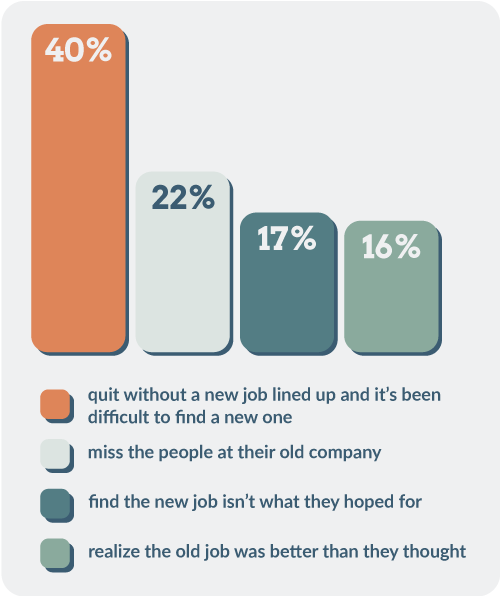
quit without a new job lined up and it's been difficult to find a new one (40%), miss the people at their old company (22%) find the new job isn't what they hoped for (17%), or realize the old job was better than they thought(16%).

So if former employees regret their decision, and want to come back to you, do you take them?

Why not, says Jessica Kriegel, chief scientist of workplace culture at Culture Partners.

“The reality is the highest performing companies in the world have robust ‘boomerang employee’ programs and nurture alumni who have left in the hopes they will come back,” Kriegel says “‘Why?’ They feel like leaving the company … to get exposure to other organizations and then come back makes the employee more well-rounded.”

Here are four things to consider when it comes to boomerang employees in the midst of The Great Regret.

Pick up where you left off

If you parted on good terms, it’s more likely you and ex-employees who feel the regret will benefit from a reunion. The key to bringing back good employees is a solid plan when they go.

“Ensure you make the off-boarding process and experience a positive one,” says Roberta Moore, founder of EQ-i Coach and author of Emotion at Work: Unleashing the Secret Power of Emotional Intelligence.

Critical elements to a positive breakup when an employee quits:

  • Appreciation. Thank employees for their contributions.
  • Communication. Work with the employee to decide when to tell colleagues and what information you’ll share about the departure.
  • Knowledge transfer. Assuming the position will be filled, ask the departing employee to share as much institutional knowledge to ease the transition.
  • Exit interviews. Ask for feedback on what employees liked and disliked in their time.

“It is much better to stay friendly with an employee who leaves than to burn a bridge – maybe, you will even work together again someday!” says Moore.

Consider the upside

Rehiring former employees for their same or similar roles can also save you time and money.

“Boomerang employees often require less training and bring institutional knowledge and a deep familiarity with your organization’s culture, which can lower the cost of hiring,” says Moore.

But what’s important here is to determine that potential boomerang employees were doing their jobs well and with a positive attitude before they left. You might want to check in with former managers and co-workers, plus review their performance evaluations, before deciding to rehire.

Be proactive

Rather than wait for regretful employees to come back, you might consider reaching out to them when trying to fulfill a specific role. You wouldn’t be the first.

Almost 25% of employees in the Joblist survey said previous employers had reached out to them about coming back after they quit – and more than 40% were at least open to the idea.

This again is why it’s important to try to part ways with employees on good terms. Encourage managers to stay connected with employees who they’d be open to coming back after they leave. Obviously, social media and professional tools such as LinkedIn make this easier.

Focus on retention

Ideally, you can help employees avoid The Great Regret with retention, keeping them happy exactly where they are.

“Employers will likely still face challenges around employee retention and recruitment,” says Nadia Vatalidis, VP of people at Remote. “Employers focused on supporting a strong life/work balance for their teams, as well as implementing effective recruitment strategies for the year ahead, will be in the best position to drive sustained success into 2024 and beyond.”

Filed under
  • Staff Departure
  • Share on

Get the HRMorning Newsletter

With HRMorning arriving in your inbox, you will never miss critical stories on labor laws, benefits, retention and onboarding strategies.

  • This field is for validation purposes and should be left unchanged.
  • This field is hidden when viewing the form
  • This field is hidden when viewing the form
  • This field is hidden when viewing the form
  • This field is hidden when viewing the form
  • This field is hidden when viewing the form
  • This field is hidden when viewing the form
  • This field is hidden when viewing the form
  • This field is hidden when viewing the form
  • This field is hidden when viewing the form
  • This field is hidden when viewing the form
  • This field is hidden when viewing the form
  • This field is hidden when viewing the form
  • This field is hidden when viewing the form
  • This field is hidden when viewing the form
  • This field is hidden when viewing the form
  • This field is hidden when viewing the form
  • This field is hidden when viewing the form
  • This field is hidden when viewing the form
  • This field is hidden when viewing the form
  • This field is hidden when viewing the form
  • This field is hidden when viewing the form
  • This field is hidden when viewing the form
  • This field is hidden when viewing the form
  • This field is hidden when viewing the form
  • This field is hidden when viewing the form
  • This field is hidden when viewing the form
  • This field is hidden when viewing the form
  • This field is hidden when viewing the form
  • This field is hidden when viewing the form
  • This field is hidden when viewing the form
  • This field is hidden when viewing the form
  • This field is hidden when viewing the form
  • This field is hidden when viewing the form
  • This field is hidden when viewing the form
  • This field is hidden when viewing the form
  • This field is hidden when viewing the form
  • This field is hidden when viewing the form
  • This field is hidden when viewing the form
  • This field is hidden when viewing the form
  • This field is hidden when viewing the form
  • This field is hidden when viewing the form
  • This field is hidden when viewing the form
  • This field is hidden when viewing the form
  • This field is hidden when viewing the form
  • This field is hidden when viewing the form
  • This field is hidden when viewing the form
  • This field is hidden when viewing the form
  • This field is hidden when viewing the form
  • This field is hidden when viewing the form
  • This field is hidden when viewing the form
  • This field is hidden when viewing the form
  • This field is hidden when viewing the form
  • This field is hidden when viewing the form
  • This field is hidden when viewing the form
  • This field is hidden when viewing the form
  • This field is hidden when viewing the form

Free Training & Resources

White Papers

9 Questions to Determine if It is Time to Reboot Your Employee Discount Program

Provided by PerkSpot

Webinars

Lean AP for Distributed Teams: Unify Approvals, Invoices, and Payments

Provided by Yooz

White Papers

Demystifying HSAs: Breaking down recent HSA trends and myths

Provided by Incomm

Webinars

Reduce the Manual Tasks of Your HR Department

SPONSORED CONTENT

HR Technology

sponsored content
The Best AI Software for HR Automation

Courtesy of G-P

Talent Management

sponsored content
Powerful Employee Retention Strategies for 2025: How to Keep Your Best People

Courtesy of PEOPLEGURU

Benefits

Health Care

Wellness

sponsored content
Proven Results: 5 Ways Teladoc Health Chronic Condition Management Transforms HR Outcomes

Courtesy of TELADOC HEALTH

Further Reading

  • Staff Departure
Non-Compete Worries? 6 Ways Engagement is the Cure

Are you worried about how the new non-compete laws will affect your organization? Perhaps you could lose top talent? Or maybe you won’...

  • Recruiting
  • Staff Departure
4 questions to ask to engage your new hires (and keep them)

Onboarding new hires is an often-missed opportunity for crucial early employee engagement. That’s according to Tina Schust Robinso...

  • Staff Departure
Truth Behind Rage Quitting: 5 Ways to Respond

Is Rage Quitting still all the rage? And, if so, what can HR professionals do to curb it? You might feel like turnover is out of control...

  • Staff Departure
The Big Stay means ‘disgruntled stayers’: 8 ways to re-engage everyone

Just because employees stay — and created The Big Stay — doesn’t mean they’re happy. In fact, many are “di...

  • Staff Departure
Employee Termination Checklist: 6 Critical Steps

Making the decision to terminate an individual’s employment is never easy. Having a checklist to keep track of all the steps in ...

  • Leadership & Strategy
  • Recruiting
What to do about ‘shift shock’ – the No. 1 reason why Gen Z and Millennial workers are quitting

Shift shock occurs when there’s a surprise disconnect between a new hire’s expectations for their employee experience and what ...

Get the latest from HRMorning in your inbox PLUS immediately access 10 FREE HR guides.

I WANT MY FREE GUIDES
HR Morning Logo
  • Facebook
  • Linked In
  • ABOUT HRMORNING
  • ADVERTISE WITH US
  • WRITE FOR US
  • CONTACT
  • Employment Law
  • Benefits
  • Recruiting
  • Talent Management
  • Performance Management
  • HR Technology
  • Leadership & Strategy
  • Compensation
  • Policy & Procedures
  • Wellness
  • Staff Departure
  • HR Career & Self-Care
  • Health Care
  • Retirement Plans
  • DEI

HRMorning, part of the Rover Insights Network, provides the latest HR and employment law news for HR professionals in the trenches of small-to-medium-sized businesses. Rather than simply regurgitating the day's headlines, HRMorning delivers actionable insights, helping HR execs understand what HR trends mean to their business.

Powered By Rover Insights
Privacy Policy | Terms of Service
Copyright© 2026 Rover Insights
HRMorning Logo

WELCOME BACK!

Enter your username and password below to log in

Forget Your Username or Password?

Reset Password

Lost your password? Please enter your username or email address. You will receive a link to create a new password via email.

Log In

Why do we need your credit card for a free trial?

We ask for your credit card to allow your subscription to continue should you decide to keep your membership beyond the free trial period.  This prevents any interruption of content access.

Your card will not be charged at any point during your 21 day free trial
and you may cancel at any time during your free trial.

During your free trial, you can cancel at any time with a single click on your “Account” page.  It’s that easy.