• Skip to primary navigation
  • Skip to main content

HRMorning

  • FREE RESOURCES
  • PREMIUM CONTENT
  • HR DEEP DIVES
  • PODCASTS
    • VOICES OF HR
    • WOMEN’S LEADERSHIP TODAY
  • LOGIN
  • SIGN UP FREE
  • Employment Law
  • Benefits
  • Recruiting
  • HR Technology
  • Payroll
  • Management
  • Women’s Leadership
  • More
    • Talent Management
    • Performance Management
    • Leadership & Strategy
    • Compensation
    • Policy & Procedures
    • Wellness
    • Staff Departure
    • HR Career & Self-Care
    • Health Care
    • Retirement Plans
RM Logo
  • Performance Management

8 Worst Co-Workers and How to Handle Them Without Losing Your Cool

Michele McGovern
By: Michele McGovern
  • Share on

About the Author

Michele McGovern writes. A lot. These days, she covers HR, digging deep into company culture, DEI, leadership, management and the everchanging world of work. In the years between getting a BA in journalism from a state school and writing about HR, she wrote about big-city crime for a wire service and small-town life for local newspapers. She’s a mediocre mom, decent wife, wannabe athlete and consummate pursuer of fun - on land, snow and water. Find her on LinkedIn @michele-mcgovern-writer.

Show Less
Last Updated: January 30, 2026
5 minute engagement

There’s the employee who knows it all. Or the manager who steals your great ideas. Then there’s the guy who leaves a mess everywhere.

They’re some of the worst co-workers.

And as a manager, you have to handle them — all the while, without losing your cool.

They may not be toxic, but they’re disruptive. And, as a leader, you likely get complaints about their annoying behavior from employees and colleagues.

Worst Co-Workers Everywhere

In fact, 85% of employees say they have at least one annoying co-worker, according to a Kickresume survey.

Unfortunately, you and your employees can’t just suck it up when it comes to disruptive co-workers. Annoying workplace behaviors have consequences: Nearly 60% say their co-workers’ behavior affects their productivity.

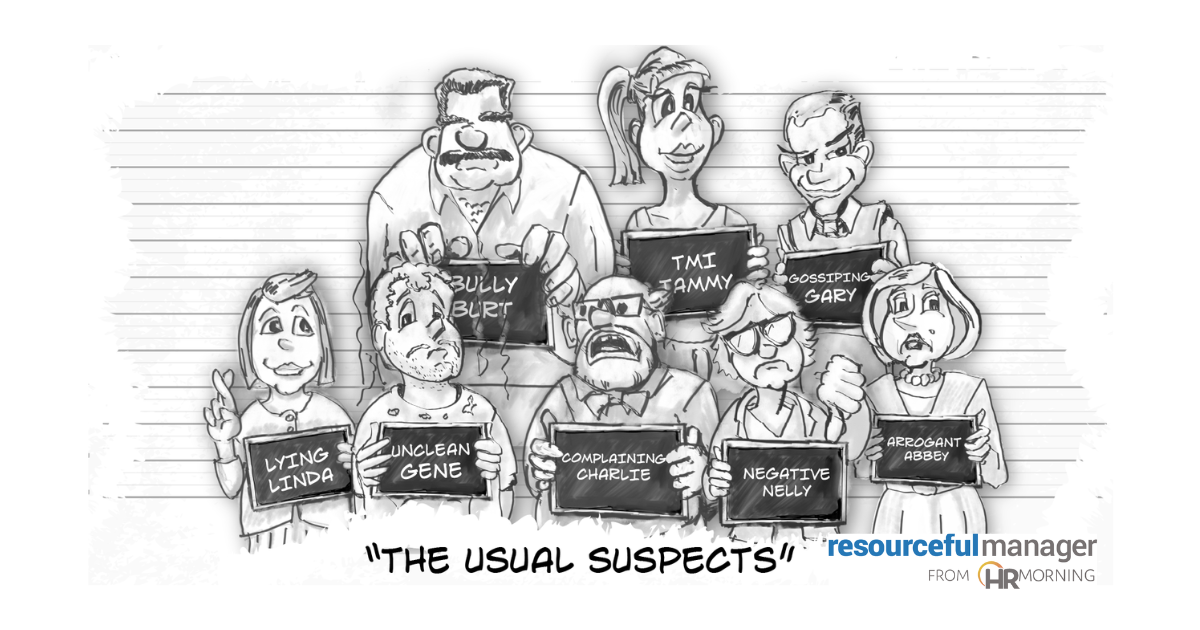
Here are eight of the worst co-workers, and tips on how to handle them.

1. Gossiping Gary

Gossip is rarely positive. And that’s probably why many employees say it’s the worst trait co-workers can have.

Gossiping Gary and others like him hurt morale, upset colleagues and distract nearly everyone from what’s important. Unfortunately, Gary often has listeners who spread his gossip, causing widespread damage.

Tip: Obviously, the best solution is to avoid gossip. But that won’t make it go away. Try to counteract it with positive gossip. When you hear something negative, say something positive about the person or situation. Spread good news quietly, making it a secret that others want in on.

2. Lying Linda

Lying Linda tells false stories for many reasons — to hide errors, compensate for weaknesses, bring down others, get ahead …. That’s what makes her another awful co-worker.

Fortunately, many employees are willing to call out colleagues for their poor or unprofessional behavior. And Lying Linda could be the one who needs to be called out most.

Tip: Call her out. The more she gets away with lies, the more she’ll do it, and eventually, no one will know the truth. The more she’s called out, the less she’ll do it.

3. Negative Nellie

She’s. The. Worst.

She finds fault in everything — from policies and practices to people and places. Negative Nellie is the first one to point out what could go wrong. And if something does go wrong, she’s quick to say, “Told you so.”

Her attitude can bring down people, and the effect can be the worst on new employees who don’t recognize her for what she is.

Tip: As much as possible, allow negative employees to work alone. Oftentimes, they prefer the autonomy, too. While you don’t want to isolate anyone in the workplace, give them fewer opportunities to work in groups where they might poison the well.

4. TMI Tammy

Too-Much-Information Tammy shares way more than anyone wants to know and asks too many questions of colleagues. But mostly she likes to tell colleagues things that you don’t want to hear — about medical conditions, love life, family drama and beyond.

Tip: Steer Tammy and other TMIers back to professional, work-related conversations when they get off track. For instance, “Tammy, while I’d like to catch up on that, we need to finish this report for the client. Can you give me the data points now?”

5. Complaining Charlie

This one complains about everything. To everyone. He might dislike you and tell the team. He might hate the work and tell your boss.

Complaining Charlie definitely doesn’t like the changes – and tells everyone that, which will get in the way of progress. He always finds something to complain about at work.

But one of the most dangerous things about Complaining Charlie is that he can cause you to stop listening and assume he’s crying wolf.

Tip: To avoid turning your back on a real complaint, ask Complaining Charlie to offer two solutions for every complaint he brings.

6. Arrogant Abby

Arrogant Abby thinks she’s all that and a bag of chips. She’s often a top performer (and she knows it). So her arrogance makes it more difficult to acknowledge accomplishments because you don’t want to set her off.

The problem with Arrogant Abby is that she’s often not a team player and turns off co-workers. She prefers solo wins and enjoys telling everyone about her successes.

Tip: Fixing this can be a fine line when you handle an arrogant employee. On one hand, you don’t want to temper her confidence. On the other, you don’t want to feed her ego. So, try to strike a balance: Congratulate, reward accordingly, encourage more wins and move on.

7. Bully Burt

Bully Burt hasn’t changed much since high school. In the workplace, he still belittles others, demands too much and uses passive aggressiveness to get what he wants. What’s worse, he often does this outside of the eyes and ears of the boss, and he might make his victims feel like it’s their fault he’s being a bully.

Any bully poses several threats to a workplace – from morale to lawsuits.

Tip: You can never ignore bullying behavior. Whether you witness it or it’s reported, open an investigation immediately to be sure it’s not harassment – and if it is, follow your organization’s harassment protocols.

8. Unclean Gene

In nearly every workplace is this co-worker: Unclean Gene. Employees have issues with colleagues who lack personal hygiene.

It’s the most sensitive of subjects in work and life. But, almost every manager faces a time when they have to bring up smell, appearance or rude personal habits with an employee.

Tip: Here are our best tips ever to have sensitive conversations.

Filed under
RM Logo
  • Performance Management
  • Share on

Get the HRMorning Newsletter

With HRMorning arriving in your inbox, you will never miss critical stories on labor laws, benefits, retention and onboarding strategies.

  • This field is for validation purposes and should be left unchanged.
  • This field is hidden when viewing the form
  • This field is hidden when viewing the form
  • This field is hidden when viewing the form
  • This field is hidden when viewing the form
  • This field is hidden when viewing the form
  • This field is hidden when viewing the form
  • This field is hidden when viewing the form
  • This field is hidden when viewing the form
  • This field is hidden when viewing the form
  • This field is hidden when viewing the form
  • This field is hidden when viewing the form
  • This field is hidden when viewing the form
  • This field is hidden when viewing the form
  • This field is hidden when viewing the form
  • This field is hidden when viewing the form
  • This field is hidden when viewing the form
  • This field is hidden when viewing the form
  • This field is hidden when viewing the form
  • This field is hidden when viewing the form
  • This field is hidden when viewing the form
  • This field is hidden when viewing the form
  • This field is hidden when viewing the form
  • This field is hidden when viewing the form
  • This field is hidden when viewing the form
  • This field is hidden when viewing the form
  • This field is hidden when viewing the form
  • This field is hidden when viewing the form
  • This field is hidden when viewing the form
  • This field is hidden when viewing the form
  • This field is hidden when viewing the form
  • This field is hidden when viewing the form
  • This field is hidden when viewing the form
  • This field is hidden when viewing the form
  • This field is hidden when viewing the form
  • This field is hidden when viewing the form
  • This field is hidden when viewing the form
  • This field is hidden when viewing the form
  • This field is hidden when viewing the form
  • This field is hidden when viewing the form
  • This field is hidden when viewing the form
  • This field is hidden when viewing the form
  • This field is hidden when viewing the form
  • This field is hidden when viewing the form
  • This field is hidden when viewing the form
  • This field is hidden when viewing the form
  • This field is hidden when viewing the form
  • This field is hidden when viewing the form
  • This field is hidden when viewing the form
  • This field is hidden when viewing the form
  • This field is hidden when viewing the form
  • This field is hidden when viewing the form
  • This field is hidden when viewing the form
  • This field is hidden when viewing the form
  • This field is hidden when viewing the form
  • This field is hidden when viewing the form
  • This field is hidden when viewing the form

Free Training & Resources

White Papers

From Hire to Retire

Provided by Trinet

White Papers

Unconventional Benefits: An Employer’s Guide

Provided by Paycom

White Papers

Inspirus — 2026 Q3-4 HR Trends Report

Provided by Inspirus

White Papers

Maximizing returns: 3 methods to evaluate HR technology ROI

Provided by achievers

SPONSORED CONTENT

HR Technology

sponsored content
The Best AI Software for HR Automation

Courtesy of G-P

Talent Management

sponsored content
Powerful Employee Retention Strategies for 2025: How to Keep Your Best People

Courtesy of PEOPLEGURU

Benefits

Health Care

Wellness

sponsored content
Proven Results: 5 Ways Teladoc Health Chronic Condition Management Transforms HR Outcomes

Courtesy of TELADOC HEALTH

Further Reading

  • Performance Management
Unlock Gen Z Engagement: 7 Strategies

Generation Z, with its meme-fluent, digital-native, socially conscious culture, has staked its claim on the workplace. Between 12 and 2...

  • Performance Management
They’re Back — and Acting Badly! 5 Etiquette Reminders for RTO

More and more employees are back in the office — and they’ve forgotten how to act around co-workers. From loud, personal con...

  • Performance Management
4 Signs of a Micromanager & How to Help Them Overcome It

No one wants to be the dreaded micromanager — the one who breaks down manager-employee relationships, leads employees to quiet quitti...

  • Performance Management
Unbossing: 3 Cons, 3 Pros & 10 Takeaways

Unbossing: the systematic elimination of middle managers. If you’re an employee, unbossing sounds like a great idea — until ...

  • Performance Management
What’s Wrong with Annual Reviews – and 6 Tips to Improve Them

Annual reviews are far more dreaded than revered. Yet, despite the bad rap, companies continue to schedule performance reviews once a year....

  • Performance Management
Employee Recognition Letters: 6 Examples and Templates

When to Use Each Employee Recognition Letter [id] { scroll-margin-top: 160px; } Performance Recognition Letter – Reinforce res...

Get the latest from HRMorning in your inbox PLUS immediately access 10 FREE HR guides.

I WANT MY FREE GUIDES
HR Morning Logo
  • Facebook
  • Linked In
  • ABOUT HRMORNING
  • ADVERTISE WITH US
  • WRITE FOR US
  • CONTACT
  • Employment Law
  • Benefits
  • Recruiting
  • Talent Management
  • Performance Management
  • HR Technology
  • Leadership & Strategy
  • Compensation
  • Policy & Procedures
  • Wellness
  • Staff Departure
  • HR Career & Self-Care
  • Health Care
  • Retirement Plans
  • DEI

HRMorning, part of the Rover Insights Network, provides the latest HR and employment law news for HR professionals in the trenches of small-to-medium-sized businesses. Rather than simply regurgitating the day's headlines, HRMorning delivers actionable insights, helping HR execs understand what HR trends mean to their business.

Powered By Rover Insights
Privacy Policy | Terms of Service
Copyright© 2026 Rover Insights
HRMorning Logo

WELCOME BACK!

Enter your username and password below to log in

Forget Your Username or Password?

Reset Password

Lost your password? Please enter your username or email address. You will receive a link to create a new password via email.

Log In

Why do we need your credit card for a free trial?

We ask for your credit card to allow your subscription to continue should you decide to keep your membership beyond the free trial period.  This prevents any interruption of content access.

Your card will not be charged at any point during your 21 day free trial
and you may cancel at any time during your free trial.

During your free trial, you can cancel at any time with a single click on your “Account” page.  It’s that easy.
