• Skip to primary navigation
  • Skip to main content

HRMorning

  • FREE RESOURCES
  • PREMIUM CONTENT
  • HR DEEP DIVES
  • PODCASTS
    • VOICES OF HR
    • WOMEN’S LEADERSHIP TODAY
  • LOGIN
  • SIGN UP FREE
  • Employment Law
  • Benefits
  • Recruiting
  • HR Technology
  • Payroll
  • Management
  • Women’s Leadership
  • More
    • Talent Management
    • Performance Management
    • Leadership & Strategy
    • Compensation
    • Policy & Procedures
    • Wellness
    • Staff Departure
    • HR Career & Self-Care
    • Health Care
    • Retirement Plans
  • Employment Law

Was Safety Training Adequate? Worker Gets Hurt While Using Ladder

Tom D'Agostino
By: Tom D'Agostino
  • Share on

About the Author

Tom D’Agostino is an attorney and legal editor who has more than 30 years of experience writing about employment law, disability law and education law trends. He earned his B.A. degree from Ramapo College of New Jersey and his J.D. from the Duquesne University School of Law. D’Agostino, who is a member of the Pennsylvania bar, is a past member of the American Bar Association’s Section of Individual Rights and Responsibilities and the Pennsylvania Bar Association’s Legal Services to Persons with Disabilities Committee. He has provided technical assistance in the production of segments for television’s ABC World News and 20/20, and he has been quoted in periodicals including USA Today. He is also a past contributing author of Legal Rights of Persons with Disabilities: An Analysis of Federal Law, which is a comprehensive two-volume treatise addressing the legal rights of people with disabilities. Tom is passionate about baseball and authentic Italian food. When not writing, he enjoys spending time with family.

Show Less
Last Updated: April 2, 2024
4 minute engagement
Was Safety Training Adequate? Worker Gets Hurt While Using Ladder

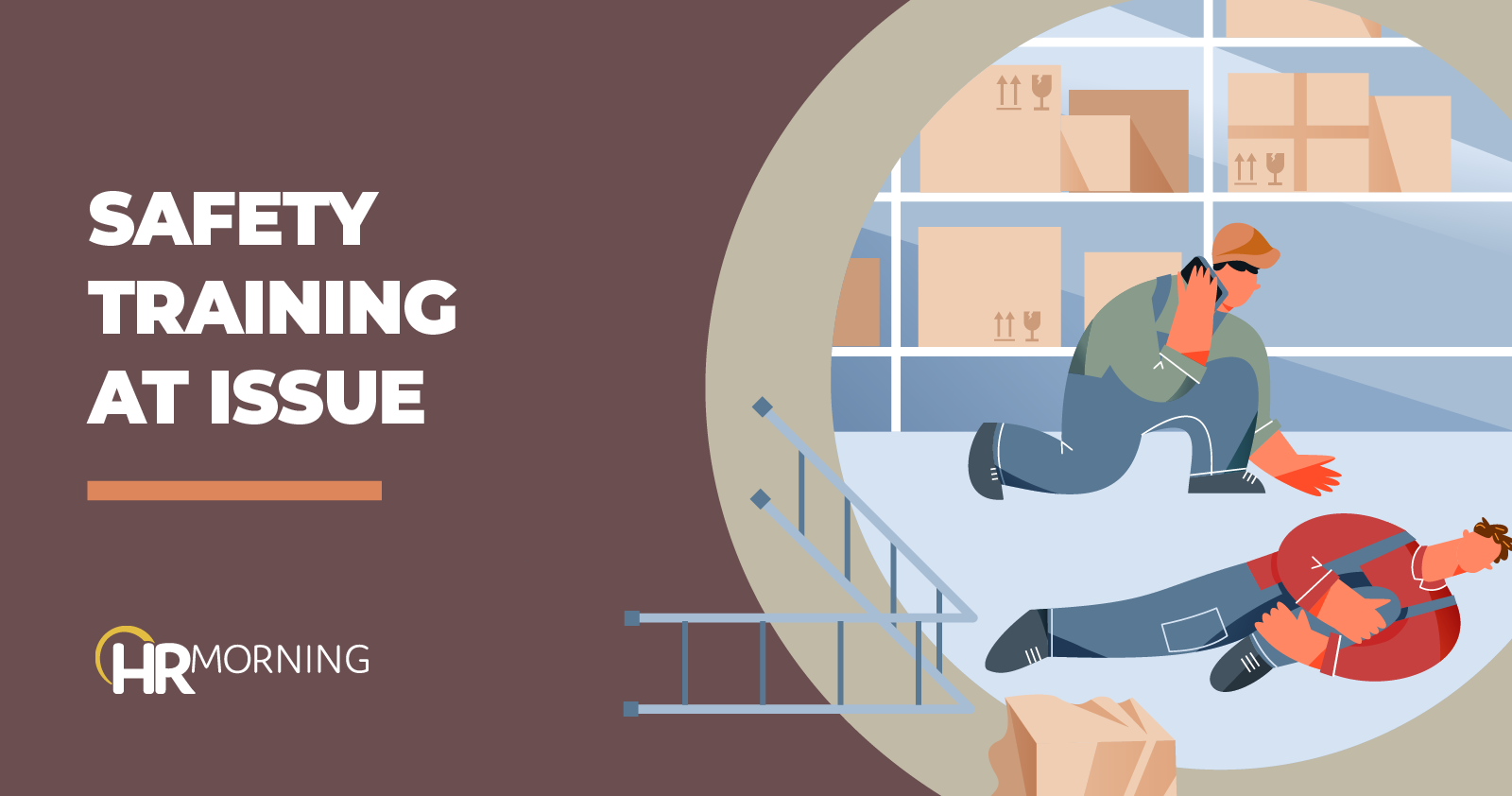
A federal court in Texas addressed safety training claims raised by a Home Depot worker who was injured while using a ladder to retrieve a bag of firewood.

Notably, the court rejected a claim that the store did not provide proper training or safety instruction on how to complete the task.

Here’s what happened.

Ice storm played a role injury

Maria Mejia Ruiz was working at a Texas Home Depot store when she sustained an injury to her hand and wrist.

On the day Mejia got hurt, there was an ice storm and only 10 employees were on duty – instead of the usual 25 to 30. The store was also busy at the time.

Mejia said that when a customer asked for help retrieving a 25-pound bag of firewood, she asked her supervisor for assistance. The supervisor allegedly told her that she “had to” get the firewood because no one was available to help.

Mejia then tried to get the job done, using what the court’s decision calls a “ladder” while explaining that it is more accurately described as “a movable staircase with a standing platform at the top.”

She says that the ladder moved while she was getting the firewood, causing the firewood to shift in her hands. As a result, she hyperextended her hand and wrist.

Lawsuit alleges lack of safety training

Mejia sued Home Depot for negligence, specifically alleging that the employer did not:

  • Train her properly and provide her with adequate safety instruction
  • Give her reasonably safe instrumentalities (equipment) to work with, and
  • Provide her with adequate assistance.

Home Depot filed a motion for summary judgment.

First, the court considered Home Depot’s argument that it did not owe Mejia a duty to provide training or safety instruction on how to retrieve the bag. Home Depot said no duty was owed because the danger associated with the task was “common knowledge” or was “already appreciated” by Mejia.

The dangers associated with lifting heavy objects and working at heights are “amongst the most commonplace risks in daily life,” the employer said.

Was the danger too common to require training?

The court said that although employers have a continuous duty to train employees regarding safety, no specific safety rules are needed if the dangers involved with the work “are obvious or are of common knowledge and fully understood by the employee.”

There is no duty to train with respect to dangers that “are commonly known or already appreciated by the employee,” the court explained.

Applying this logic, the court ruled that Home Depot did not owe Mejia a duty to train and provide adequate safety instruction regarding the task of using a ladder to retrieve a 25-pound item.

The risks associated with the tasks “would have been fully understood and appreciated by a home improvement store employee or customer.”

The court reached this result even though:

  • Mejia said the ladder shifted
  • A department supervisor testified that the automatic brakes on those ladders wear out, requiring employees to engage a manual brake, and
  • Mejia said she had never used the ladder before and did not know it had a manual brake.

Decision says safety training was provided

Even if Home Depot did have a duty to train or provide safety instruction, the court said, it did so, the court ruled.

A store safety rep testified that Home Depot provides monthly video training, and Mejia participated in it while also receiving orientation training.

All was not lost for Mejia, however, because the court refused to grant summary judgment to Home Deport on her claim that the store did not provide her with safe equipment to do the job. A fact issue is present as to the adequacy of the ladder, it decided.

The court also preserved Mejia’s claim that the store did not provide her with adequate assistance to do the job.

Home Depot admitted the task is a two-person job, the court pointed out, and the evidence permitted a finding that it involved an increased risk of injury.

The message for HR

Home Depot dodged one safety training bullet in this case, but the lawsuit continues as other claims survived. The company’s legal costs are likely to continue to pile up as the case continues to progress.

Whether it was legally required or not, more specific and intensive safety training could have avoided the whole mess for the employer.

The message: There is no substitute for providing comprehensive, ongoing safety training for employees.

Ruiz v. Home Depot U.S.A., Inc., No. 3:22-CV-2266-D, 2024 U.S. Dist. LEXIS 18498 (N.D. Tex. 2/2/24).

Filed under
  • Employment Law
  • Share on

Get the HRMorning Newsletter

With HRMorning arriving in your inbox, you will never miss critical stories on labor laws, benefits, retention and onboarding strategies.

  • This field is for validation purposes and should be left unchanged.

Free Training & Resources

White Papers

Six Pillars to Drive Impactful Engagement

Provided by Terryberry

White Papers

Maven’s State of Women’s and Family Health Benefits — 2025 Report

Provided by Maven Clinic

Webinars

Background Screening in 2027: What Changes January 1 and How to Get Ready

Provided by Mitratech

White Papers

A Year of Employee Appreciation Ideas

Provided by Inspirus

SPONSORED CONTENT

Compensation

Recruiting

sponsored content
Salary Benchmarking: 6 Choices That Decide Whether Your Pay Data Holds Up

Courtesy of MARSH

Employment Law

Policy & Procedures

sponsored content
Policy Rollout: 4 Checkpoints That Show Employees Got the Message

Courtesy of NAVEX

Benefits

Staff Administration

sponsored content
PEO ROI: 3 Numbers to Know Before You Leave Patchwork HR

Courtesy of TRINET

Further Reading

  • Compensation
  • Employment Law
FMLA Eligibility: Do ‘Bonus Hours’ Count Toward the 1,250?

FMLA eligibility usually looks straightforward: Employees need 1,250 hours of service in the prior 12 months. But the calculation isn’t a...

  • Employment Law
Transgender Issue Rocks Prison – And It’s Not the Inmates

A federal appeals court has revived a prison employee’s Title VII claim that he was subjected to severe harassment at work based on his s...

  • Employment Law
When Clients Harass Employees, Is the Employer Liable? Court Rules

It’s a relatively uncommon type of Title VII claim, but it happens: An employee sues their employer based on alleged harassment not by a ...

  • Employment Law
New DOL Wage Investigation Policy Gives HR a Strategic Edge: What to Know Now

While political headlines dominated the news cycle, the Department of Labor (DOL) quietly issued a new field bulletin that could reshape ho...

  • Employment Law
Get ready: Religious accommodation duty may be expanding soon

The scope of the duty to provide religious accommodation to employees may well expand in 2023. On Jan. 13, the U.S. Supreme Court agreed...

  • Employment Law
Free the beard: EEOC targets religious discrimination based on facial hair

Word to the wise: The Equal Opportunity Employment Commission (EEOC) is cracking down on religious discrimination based on facial hair, as ...

Get the latest from HRMorning in your inbox PLUS immediately access 10 FREE HR guides.

I WANT MY FREE GUIDES
HR Morning Logo
  • Facebook
  • Linked In
  • ABOUT HRMORNING
  • ADVERTISE WITH US
  • WRITE FOR US
  • CONTACT
  • Employment Law
  • Benefits
  • Recruiting
  • Talent Management
  • Performance Management
  • HR Technology
  • Leadership & Strategy
  • Compensation
  • Policy & Procedures
  • Wellness
  • Staff Departure
  • HR Career & Self-Care
  • Health Care
  • Retirement Plans
  • DEI

HRMorning, part of the Rover Insights Network, provides the latest HR and employment law news for HR professionals in the trenches of small-to-medium-sized businesses. Rather than simply regurgitating the day's headlines, HRMorning delivers actionable insights, helping HR execs understand what HR trends mean to their business.

Powered By Rover Insights
Privacy Policy | Terms of Service
Copyright© 2026 Rover Insights
HRMorning Logo

WELCOME BACK!

Enter your username and password below to log in

Forget Your Username or Password?

Reset Password

Lost your password? Please enter your username or email address. You will receive a link to create a new password via email.

Log In

Why do we need your credit card for a free trial?

We ask for your credit card to allow your subscription to continue should you decide to keep your membership beyond the free trial period.  This prevents any interruption of content access.

Your card will not be charged at any point during your 21 day free trial
and you may cancel at any time during your free trial.

During your free trial, you can cancel at any time with a single click on your “Account” page.  It’s that easy.