• Skip to primary navigation
  • Skip to main content

HRMorning

  • FREE RESOURCES
  • PREMIUM CONTENT
  • HR DEEP DIVES
  • PODCASTS
    • VOICES OF HR
    • WOMEN’S LEADERSHIP TODAY
  • LOGIN
  • SIGN UP FREE
  • Employment Law
  • Benefits
  • Recruiting
  • HR Technology
  • Payroll
  • Management
  • Women’s Leadership
  • More
    • Talent Management
    • Performance Management
    • Leadership & Strategy
    • Compensation
    • Policy & Procedures
    • Wellness
    • Staff Departure
    • HR Career & Self-Care
    • Health Care
    • Retirement Plans
RM Logo
  • Talent Management

Think You Know Your Team? Nope! Most Managers Have 4 Blind Spots

Michele McGovern
By: Michele McGovern
  • Share on

About the Author

Michele McGovern writes. A lot. These days, she covers HR, digging deep into company culture, DEI, leadership, management and the everchanging world of work. In the years between getting a BA in journalism from a state school and writing about HR, she wrote about big-city crime for a wire service and small-town life for local newspapers. She’s a mediocre mom, decent wife, wannabe athlete and consummate pursuer of fun - on land, snow and water. Find her on LinkedIn @michele-mcgovern-writer.

Show Less
Last Updated: December 9, 2025
4 minute engagement

As a manager, you probably think you know your team really well. But it may not be enough.

And that could hurt outcomes.

Nearly two-thirds of managers are out of touch with their teams and how they behave, the TeamDynamics State of the Team Report found.

But that’s not all.

“Managers’ biggest blind spots come from not understanding how their team truly works,” says Christopher Morrison, Founder of TeamDynamics. “They either don’t know, or assume — mostly incorrectly! — that their team shares their personal communication and collaboration preferences.”

Learning to Know Your Team

Of course, every team has its own dynamics. And you’re a responsible leader who strives to know, understand and lead your team. But that’s why they’re called blind spots — no one can see what they don’t see.

The researchers uncovered four main blind spots when it comes to understanding a team. They’re a guide for potential disconnects on your teams — or even the teams you support or rely on.

“The first step in overcoming a manager’s blind spots is straightforward: Diagnose where they are!” says Morrison.

Here are the blind spots, plus tips to bridge the gaps, manage better and hit goals every time.

Blind Spot 1: Dynamics

Just about 35% of managers can accurately describe each of their team members’ core behaviors.

As the researchers put it: “This means that nearly two out of every three managers are likely engaging with their team incorrectly along at least one of their team’s core ways of working.”

Sure, people’s working styles often adapt to the circumstances. For instance, under a tight deadline, people tend to speed up their pace of work.

But core behaviors tend to stick like glue. For example, Evelyn will probably always have her work done ahead of time. Or Tyrone will thrive under last-minute pressure. Those are things managers want to understand — and stay in tune with when managing.

“If left unaddressed, the disconnect between a manager’s understanding and how their team actually works can erode team communication, analysis decision-making and execution,” says Morrison.

Tip: Try a behavioral assessment — you can use free or subscription tools. They can help you benchmark individual and team behavioral norms and build a baseline for your team dynamics as far as communication and collaboration. “With this insight, managers can incorporate these behaviors into core processes, document them in team norms and kickoffs, use them in coaching and apply them during recruitment and onboarding,” says Morrison.

Blind Spot 2: Organization

We’re creatures of habit and order. Proof: 70% of people prefer their teams to use detailed plans when they execute projects. But just 27% of teams actually do this.

Most of your team members want to know where you stand, where you’re headed and how you’ll get there. When they’re organized, they can be more agile and adaptable to change.

“When teams don’t follow their preferred approach for executing projects, they’ll reduce team efficiency, wasting precious team time and energy,” says Morrison. “Beyond delaying projects, this can gradually increase team frustration and lead to disengagement and burnout.”

Tip: Get a new plan, Stan! Or any plan. The point is that most teams need more direction than their bosses provide. With every project or goal, get your team’s insight on how to execute, then build a plan from their ideas.

Blind Spot 3: Communication

When it comes to team communication, employees feel similar to how they feel about projects and plans: Three-quarters want it structured and orderly. But just about 40% of teams handle it that way — and many leaders don’t see that problems can arise when communication preferences aren’t aligned.

“Poor communication from a manager creates confusion and misalignment on goals,” says Morrison. “Team members lack the necessary context to act independently, lowering morale and engagement. Misunderstandings can also lead to avoidable conflicts.”

Tip: This is definitely a situation that calls for aligning expectations and delivery. Work with your team to decide the ways you all can communicate most effectively. Set standards on the kind of information that’s best communicated across each of the channels you use. For instance, email is ideal for information sharing and Slack is best for scheduling or getting approval.

Blind Spot 4: Authority

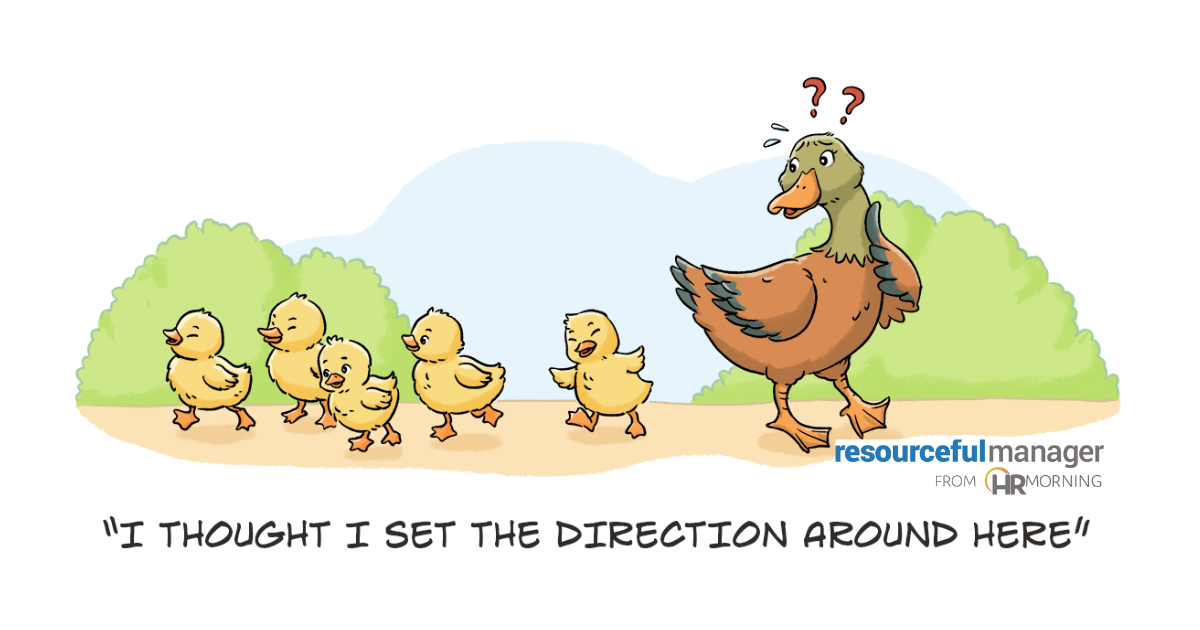
This could be the blind spot that hurts the most! Many managers believe they set the tone for their team norms. Meanwhile, just about 40% of managers are in line with team preferences. Team composition and organizational culture play a bigger role in what the team does.

“This means that nearly three in five team leaders need to flex outside their natural comfort zone to effectively manage their teams,” says Morrison. “As creatures of habit, this is hard enough for most managers; it is even harder when they are unaware of what those differences specifically are.”

Tip: Two words — situational awareness. You might be the boss, but recognize that you aren’t the boss of everything. One of the most effective leadership qualities is adaptability. When it comes to team norms, let the team set the standard. Unless the norm is ineffective, immoral or illegal, the team will likely be more productive and engaged if they influence it.

Now, here’s the best news from Morrison: “Blind spots are natural and common in team settings. Acknowledging them, learning to identify them and taking constructive action can make you a more effective and inspiring leader.”

Filed under
RM Logo
  • Talent Management
  • Share on

Get the HRMorning Newsletter

With HRMorning arriving in your inbox, you will never miss critical stories on labor laws, benefits, retention and onboarding strategies.

  • This field is for validation purposes and should be left unchanged.
  • This field is hidden when viewing the form
  • This field is hidden when viewing the form
  • This field is hidden when viewing the form
  • This field is hidden when viewing the form
  • This field is hidden when viewing the form
  • This field is hidden when viewing the form
  • This field is hidden when viewing the form
  • This field is hidden when viewing the form
  • This field is hidden when viewing the form
  • This field is hidden when viewing the form
  • This field is hidden when viewing the form
  • This field is hidden when viewing the form
  • This field is hidden when viewing the form
  • This field is hidden when viewing the form
  • This field is hidden when viewing the form
  • This field is hidden when viewing the form
  • This field is hidden when viewing the form
  • This field is hidden when viewing the form
  • This field is hidden when viewing the form
  • This field is hidden when viewing the form
  • This field is hidden when viewing the form
  • This field is hidden when viewing the form
  • This field is hidden when viewing the form
  • This field is hidden when viewing the form
  • This field is hidden when viewing the form
  • This field is hidden when viewing the form
  • This field is hidden when viewing the form
  • This field is hidden when viewing the form
  • This field is hidden when viewing the form
  • This field is hidden when viewing the form
  • This field is hidden when viewing the form
  • This field is hidden when viewing the form
  • This field is hidden when viewing the form
  • This field is hidden when viewing the form
  • This field is hidden when viewing the form
  • This field is hidden when viewing the form
  • This field is hidden when viewing the form
  • This field is hidden when viewing the form
  • This field is hidden when viewing the form
  • This field is hidden when viewing the form
  • This field is hidden when viewing the form
  • This field is hidden when viewing the form
  • This field is hidden when viewing the form
  • This field is hidden when viewing the form
  • This field is hidden when viewing the form
  • This field is hidden when viewing the form
  • This field is hidden when viewing the form
  • This field is hidden when viewing the form
  • This field is hidden when viewing the form
  • This field is hidden when viewing the form
  • This field is hidden when viewing the form
  • This field is hidden when viewing the form
  • This field is hidden when viewing the form
  • This field is hidden when viewing the form
  • This field is hidden when viewing the form
  • This field is hidden when viewing the form

Free Training & Resources

Webinars

Pieced Together Isn’t a Program: How to Take Control of Your Employee Engagement Strategy

Provided by Terryberry

Webinars

Remote Recruiting, Interviewing, Hiring, and Onboarding During COVID-19

White Papers

The Employer’s Guide to Lowering Healthcare Spend Without Losing Coverage

Provided by Personify Health

Webinars

Improve New-Hire Engagement with Digital Onboarding

SPONSORED CONTENT

HR Technology

sponsored content
The Best AI Software for HR Automation

Courtesy of G-P

Talent Management

sponsored content
Powerful Employee Retention Strategies for 2025: How to Keep Your Best People

Courtesy of PEOPLEGURU

Benefits

Health Care

Wellness

sponsored content
Proven Results: 5 Ways Teladoc Health Chronic Condition Management Transforms HR Outcomes

Courtesy of TELADOC HEALTH

Further Reading

  • Talent Management
4 eco-friendly benefits of remote work: Create a people-first and planet-first workplace

Remote work has countless benefits, from financial advantages like a reduced need for childcare and less money spent on commuting to person...

  • Talent Management
Financial Stress Is Showing Up at Work: How HR Can Respond

Financial stress knows no income boundaries. Bank of America research shows that even among families earning more than $150,000 a year, one...

  • Talent Management
10 Tips to Improve Employee Engagement

HR professionals might consider employee engagement the glue that holds company success together. No matter what you talk about – prod...

  • Performance Management
  • Talent Management
Employee Recognition: HR’s Ultimate Guide

Losing and replacing an employee can cost up to 150% of their salary. And most of that loss doesn’t start at the exit interview – it bu...

  • Talent Management
Love an employee, but it’s not a good fit now? 5 questions to figure out what’s next

Most HR pros and front-line managers come to this fork in the road: You love an employee but are finding it’s not a good fit anymore....

  • Talent Management
Powerful Employee Retention Strategies for 2025: How to Keep Your Best People

Presented by HRMorning and sponsored by PeopleGuru Employee retention strategies are more important than ever in 2025. With rising ...

Get the latest from HRMorning in your inbox PLUS immediately access 10 FREE HR guides.

I WANT MY FREE GUIDES
HR Morning Logo
  • Facebook
  • Linked In
  • ABOUT HRMORNING
  • ADVERTISE WITH US
  • WRITE FOR US
  • CONTACT
  • Employment Law
  • Benefits
  • Recruiting
  • Talent Management
  • Performance Management
  • HR Technology
  • Leadership & Strategy
  • Compensation
  • Policy & Procedures
  • Wellness
  • Staff Departure
  • HR Career & Self-Care
  • Health Care
  • Retirement Plans
  • DEI

HRMorning, part of the Rover Insights Network, provides the latest HR and employment law news for HR professionals in the trenches of small-to-medium-sized businesses. Rather than simply regurgitating the day's headlines, HRMorning delivers actionable insights, helping HR execs understand what HR trends mean to their business.

Powered By Rover Insights
Privacy Policy | Terms of Service
Copyright© 2026 Rover Insights
HRMorning Logo

WELCOME BACK!

Enter your username and password below to log in

Forget Your Username or Password?

Reset Password

Lost your password? Please enter your username or email address. You will receive a link to create a new password via email.

Log In

Why do we need your credit card for a free trial?

We ask for your credit card to allow your subscription to continue should you decide to keep your membership beyond the free trial period.  This prevents any interruption of content access.

Your card will not be charged at any point during your 21 day free trial
and you may cancel at any time during your free trial.

During your free trial, you can cancel at any time with a single click on your “Account” page.  It’s that easy.
