• Skip to primary navigation
  • Skip to main content

HRMorning

  • FREE RESOURCES
  • PREMIUM CONTENT
  • HR DEEP DIVES
  • PODCASTS
    • VOICES OF HR
    • WOMEN’S LEADERSHIP TODAY
  • LOGIN
  • SIGN UP FREE
  • Employment Law
  • Benefits
  • Recruiting
  • HR Technology
  • Payroll
  • Management
  • Women’s Leadership
  • More
    • Talent Management
    • Performance Management
    • Leadership & Strategy
    • Compensation
    • Policy & Procedures
    • Wellness
    • Staff Departure
    • HR Career & Self-Care
    • Health Care
    • Retirement Plans
RM Logo
  • Leadership & Strategy

7 Things You Should Never Say When $#!t Hits the Fan

Michele McGovern
By: Michele McGovern
  • Share on

About the Author

Michele McGovern writes. A lot. These days, she covers HR, digging deep into company culture, DEI, leadership, management and the everchanging world of work. In the years between getting a BA in journalism from a state school and writing about HR, she wrote about big-city crime for a wire service and small-town life for local newspapers. She’s a mediocre mom, decent wife, wannabe athlete and consummate pursuer of fun - on land, snow and water. Find her on LinkedIn @michele-mcgovern-writer.

Show Less
Last Updated: June 8, 2026
5 minute engagement

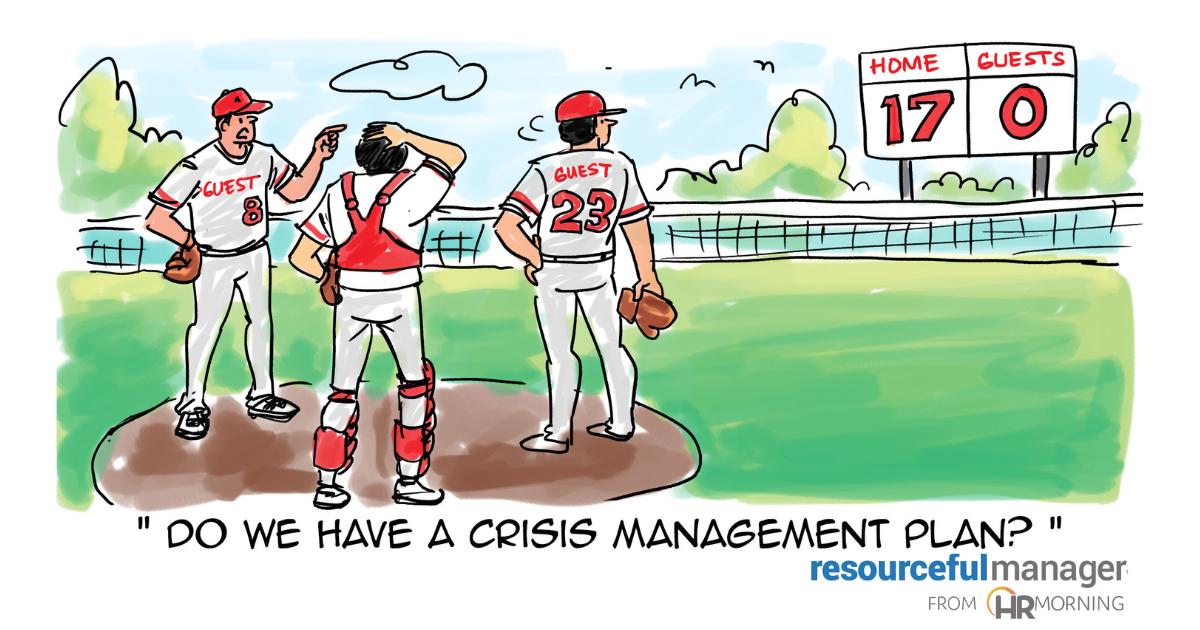
It’s bad enough when $#!t hits the fan. Say or do the wrong thing in the midst of a crisis, and you’ll almost always make it worse.

So there are some things leaders should never say — write, post, record or relay — when things go wrong.

And things will go wrong.

Nearly all companies have experienced some kind of disruption in the past few years, according to research from PwC. As a result, nearly as many have created a crisis management, resilience or reaction plan.

Never Say v. Say

Crisis at work can run the gamut — from one team member’s personal loss that affects the group to a major organizational issue that threatens operations, employees and customers.

Regardless of how, when and where the $#!t hits the fan, managers have to communicate the right information at the right time and place.

“In a crisis, every second counts,” says Robert Dilenschneider, author of The Ultimate Guide to Power & Influence: Everything You Need to Know. “Quick decision-making, clear communication, and a unified message can make the difference between a company that survives and thrives.”

Here’s a quick guide on what not to say — and what to say or do — when $#!t hits the fan at work.

1. Tell It All — Fast

Never say: Something has happened. I’ll let you know more when I have more information.

Say: Our biggest client fired us. This will affect assignments, workloads and, potentially, our jobs. While that’s a last resort, it’s possible. The leadership team will have a plan in place and share it by the end of this week.

Reason: “The best strategy is to tell it all and tell it fast,” says Dilenschneider. People would rather know bad news — and some details on how it might be handled — than know nothing at all.

Outcome: When you’re as straight and fast as possible with anyone affected by the crisis, you’ll build credibility immediately.

2. Speak to the Audience

Never say: The company will need to assess the cause, effects and outcomes we expect.

Say: The product recall will affect all of us to some capacity. Immediately, our company will face scrutiny in the media and on social media. We know this can be embarrassing and frustrating for you. You can talk confidentially with me or HR if you want to share personal concerns.

Reason: You want to “talk from the viewpoint of your audience and to their self-interest,” says Dilenschneider. Almost everyone who’s affected by $#!t hitting the fan wants to know how it truly affects them.

Outcome: Employees will receive negative information and situations with better attitudes when you acknowledge how it can affect them. Even better, give them tools to respond to what’s happened.

3. Paint a Clear Picture

Never say: We’re investigating the incident.

Say: The HR manager, VP and I are talking with everyone who witnessed the crash in the warehouse to determine what went wrong.

Reason: “Avoid jargon and euphemisms. An explosion is not an incident,” says Dilenschneider. You don’t want to underplay or over-generalize what’s happened. People will visualize something worse, fill in gaps with fallacies or underestimate the impact if they don’t get a clear picture of what’s going on.

Outcome: Anyone affected by the issue will understand better how to react and move forward when they “see” the reality.

4. Own Mistakes

Never say: We think the production and shipping department caused the problem.

Say: We are sending customers replacement products for free. We’ll review our fulfillment process once we’ve satisfied every customer to find the best ways to improve it.

Reason: You don’t want to point fingers when things go wrong. You want to find and execute solutions.

Outcome: Ideally, everyone involved can take some credit for solving problems, overcoming issues and improving your situation. And no one takes blame.

5. Tell the Truth

Never say: Everything will be OK.

Say: Because of the recall, we anticipate we’ll lose 25% of revenue this year. That will likely lead to cutbacks in payroll and production.

Reason: “Tell the truth, even if it hurts,” says Dilenschneider. “Don’t be defensive.” If you become defensive — it’s often a natural reaction — when people ask more questions, you’ll create more tension and barriers at a time when alignment is key to moving forward.

Outcome: Employees can plan for their personal futures — and what’s best for them — when they understand the business impact of the issue.

6. Skip Clichés

Never say: Our thoughts and prayers are with them.

Say: I am sad. We, as a company, want to help our colleagues. This is what we plan to do to help them through this difficult situation.

Reason: When bad things happen to employees or clients at work, clichés sound insincere and are useless. People need to hear their leaders and organization have emotions and the sense to do things to help when their people need it.

Outcome: You’ll create goodwill and a stronger sense of community when you show emotion and take action, rather than just deliver lip service.

7. Say All You Can

Never say: I can’t tell you anything.

Say: What I can tell you is, this is an HR matter, and for the privacy of employees involved, and for legal reasons, I can’t share much. But I do want you to know that this is how the investigation will affect our department …

Reason: “Never say ‘no comment,'” says Dilenschneider. “If the information is private — say, about personnel — explain the reason. Then find something else to say.” If you don’t share something, everyone involved will fill in holes with speculation, gossip and possibly all-out lies.

Outcome: With some information, everyone involved should be satisfied enough to leave speculation out of the equation.

Filed under
RM Logo
  • Leadership & Strategy
  • Share on

Get the HRMorning Newsletter

With HRMorning arriving in your inbox, you will never miss critical stories on labor laws, benefits, retention and onboarding strategies.

  • This field is for validation purposes and should be left unchanged.
  • This field is hidden when viewing the form
  • This field is hidden when viewing the form
  • This field is hidden when viewing the form
  • This field is hidden when viewing the form
  • This field is hidden when viewing the form
  • This field is hidden when viewing the form
  • This field is hidden when viewing the form
  • This field is hidden when viewing the form
  • This field is hidden when viewing the form
  • This field is hidden when viewing the form
  • This field is hidden when viewing the form
  • This field is hidden when viewing the form
  • This field is hidden when viewing the form
  • This field is hidden when viewing the form
  • This field is hidden when viewing the form
  • This field is hidden when viewing the form
  • This field is hidden when viewing the form
  • This field is hidden when viewing the form
  • This field is hidden when viewing the form
  • This field is hidden when viewing the form
  • This field is hidden when viewing the form
  • This field is hidden when viewing the form
  • This field is hidden when viewing the form
  • This field is hidden when viewing the form
  • This field is hidden when viewing the form
  • This field is hidden when viewing the form
  • This field is hidden when viewing the form
  • This field is hidden when viewing the form
  • This field is hidden when viewing the form
  • This field is hidden when viewing the form
  • This field is hidden when viewing the form
  • This field is hidden when viewing the form
  • This field is hidden when viewing the form
  • This field is hidden when viewing the form
  • This field is hidden when viewing the form
  • This field is hidden when viewing the form
  • This field is hidden when viewing the form
  • This field is hidden when viewing the form
  • This field is hidden when viewing the form
  • This field is hidden when viewing the form
  • This field is hidden when viewing the form
  • This field is hidden when viewing the form
  • This field is hidden when viewing the form
  • This field is hidden when viewing the form
  • This field is hidden when viewing the form
  • This field is hidden when viewing the form
  • This field is hidden when viewing the form
  • This field is hidden when viewing the form
  • This field is hidden when viewing the form
  • This field is hidden when viewing the form
  • This field is hidden when viewing the form
  • This field is hidden when viewing the form
  • This field is hidden when viewing the form
  • This field is hidden when viewing the form
  • This field is hidden when viewing the form
  • This field is hidden when viewing the form

Free Training & Resources

White Papers

Unconventional Benefits: An Employer’s Guide

Provided by Paycom

Webinars

State Mandates and the Future of Retirement: How Smart Employers are Acting Now

Provided by Ubiquity

White Papers

The Retention Dilemma: Mitigating High Employee Turnover in The U.S.

Provided by PeopleGuru

Webinars

Creating a Safe, Supportive Environment: How HR Can Bridge the Gap Between Safety and the Needs of Your Employees

SPONSORED CONTENT

HR Technology

sponsored content
The Best AI Software for HR Automation

Courtesy of G-P

Talent Management

sponsored content
Powerful Employee Retention Strategies for 2025: How to Keep Your Best People

Courtesy of PEOPLEGURU

Benefits

Health Care

Wellness

sponsored content
Proven Results: 5 Ways Teladoc Health Chronic Condition Management Transforms HR Outcomes

Courtesy of TELADOC HEALTH

Further Reading

  • Leadership & Strategy
5 Ways to Navigate Political Discourse at Work

Political conversations can make people uncomfortable. Worse, politics can actually have an impact on business. In a Resume Now survey o...

  • Leadership & Strategy
How to disagree with your boss – and still have a good relationship

Your boss has a really good idea — at least she thinks so — and you hate it. Awkward, isn’t it? But how do you disagree wi...

  • Leadership & Strategy
Disability inclusion in the workplace: 3 ways to promote inclusivity

Diversity, Equity and Inclusion (DEI) should be more than a trendy sentiment. A top-notch DEI program can help promote inclusivity, further...

  • Leadership & Strategy
  • Recruiting
Is company culture the new competitive advantage for attracting, retaining top talent?

The world of work is very different from what it was a few short years ago. But if your company culture hasn’t updated with it accord...

  • Leadership & Strategy
New Report: Top 5 States, Industries for Workplace Fatalities

The American Federation of Labor and Congress of Industrial Organizations (AFL-CIO) has released its 35th annual report on health and safet...

  • Leadership & Strategy
How to Navigate the Death of a Colleague: 4 Important Strategies

Why does it feel so taboo to talk about death? It’s one of the only certainties in life, yet conversations about death, especially in the...

Get the latest from HRMorning in your inbox PLUS immediately access 10 FREE HR guides.

I WANT MY FREE GUIDES
HR Morning Logo
  • Facebook
  • Linked In
  • ABOUT HRMORNING
  • ADVERTISE WITH US
  • WRITE FOR US
  • CONTACT
  • Employment Law
  • Benefits
  • Recruiting
  • Talent Management
  • Performance Management
  • HR Technology
  • Leadership & Strategy
  • Compensation
  • Policy & Procedures
  • Wellness
  • Staff Departure
  • HR Career & Self-Care
  • Health Care
  • Retirement Plans
  • DEI

HRMorning, part of the Rover Insights Network, provides the latest HR and employment law news for HR professionals in the trenches of small-to-medium-sized businesses. Rather than simply regurgitating the day's headlines, HRMorning delivers actionable insights, helping HR execs understand what HR trends mean to their business.

Powered By Rover Insights
Privacy Policy | Terms of Service
Copyright© 2026 Rover Insights
HRMorning Logo

WELCOME BACK!

Enter your username and password below to log in

Forget Your Username or Password?

Reset Password

Lost your password? Please enter your username or email address. You will receive a link to create a new password via email.

Log In

Why do we need your credit card for a free trial?

We ask for your credit card to allow your subscription to continue should you decide to keep your membership beyond the free trial period.  This prevents any interruption of content access.

Your card will not be charged at any point during your 21 day free trial
and you may cancel at any time during your free trial.

During your free trial, you can cancel at any time with a single click on your “Account” page.  It’s that easy.