• Skip to primary navigation
  • Skip to main content

HRMorning

  • FREE RESOURCES
  • PREMIUM CONTENT
  • HR DEEP DIVES
  • PODCASTS
    • VOICES OF HR
    • WOMEN’S LEADERSHIP TODAY
  • LOGIN
  • SIGN UP FREE
  • Employment Law
  • Benefits
  • Recruiting
  • HR Technology
  • Payroll
  • Management
  • Women’s Leadership
  • More
    • Talent Management
    • Performance Management
    • Leadership & Strategy
    • Compensation
    • Policy & Procedures
    • Wellness
    • Staff Departure
    • HR Career & Self-Care
    • Health Care
    • Retirement Plans
RM Logo
  • Leadership & Strategy

27 Ways to Say No Without Upsetting Them

Michele McGovern
By: Michele McGovern
  • Share on

About the Author

Michele McGovern writes. A lot. These days, she covers HR, digging deep into company culture, DEI, leadership, management and the everchanging world of work. In the years between getting a BA in journalism from a state school and writing about HR, she wrote about big-city crime for a wire service and small-town life for local newspapers. She’s a mediocre mom, decent wife, wannabe athlete and consummate pursuer of fun - on land, snow and water. Find her on LinkedIn @michele-mcgovern-writer.

Show Less
Last Updated: March 20, 2026
4 minute engagement

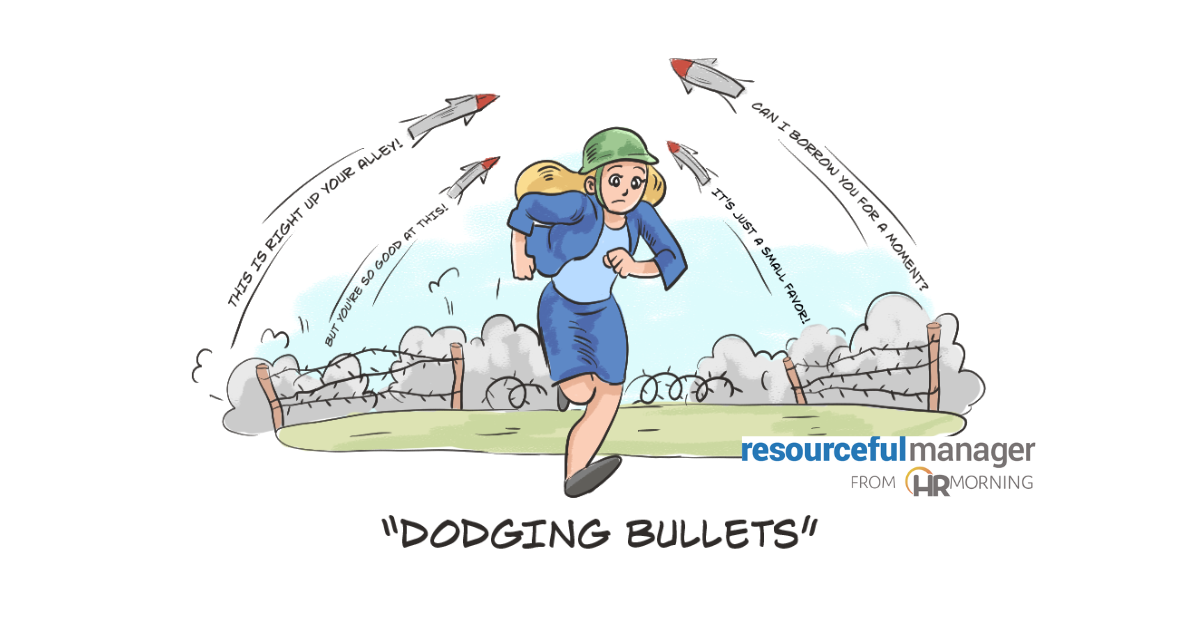
You need to say No, but you hate doing it.

After all, your boss might think you’re lazy. Or your colleague might think you’re unhelpful. Your employee will resent you. Or the client will believe you don’t care. Your friend won’t invite you next time. Or your mom will deem you unworthy.

Fortunately, there are ways to say No without coming across as lazy, unhelpful, ungrateful or — God forbid — the worst of mom’s kids!

“Saying No — even if it’s in our best interests — can feel like failure,” says Julie Bee, author of Burned: How Business Owners Can Overcome Burnout and Fuel Success.

You Need Ways to Say No

Still, as a sensible leader — who needs to sleep, eat and do things other than say Yes — you need to reject requests, decline invitations and turn down ideas. Why?

  • You can’t do it all
  • It’s not always your place to do it
  • Others gain opportunities to step up
  • Some things don’t need to be done, and
  • The stress would be overwhelming!

“That said, all Nos aren’t created equal,” says Bee. “In some situations, you’ll want to let the other person down gently and leave the door open to future collaboration. In others, you might need to set a non-negotiable boundary. Sometimes you might want to explain the reasons behind your answer; other times it’s best to answer concisely and move on.

Fortunately, Bee breaks down the differences for us and gives many ways to say No in each situation.

You Need to Set Boundaries 

Sometimes, a No is necessary so you can set boundaries to maintain your sanity or space. So you can say:

No, I do not have the capacity to ….

  • I’m working on saying No more often; this is one of those times.
  • No, but I have someone who might be a good fit. Let me check in with them.
  • Right now and into the foreseeable future, I am focusing on … Therefore, I can’t move forward with/help with …
  • No, I want to create more space on my calendar, which means I’m turning down some things I would have said Yes to in the past. 
  • I am already over-committed/have a full plate, and I would not be able to give this the attention it needs/deserves. I have to say No. 
  • I recognize that what you are doing is important/has value, but at this time I can’t participate/listen/attend.
  • I promised my kids/spouse/family/employees/etc. I would say No to any new requests that interfere with weekends/evenings/focused work/team time, so I am saying No. 

You Can’t Do It Now

Many times, you have to say No because you don’t have the time now or in the foreseeable future. Say:

  • No, at this time, but please follow up with me in (weeks/months) when I may have more capacity to review/participate/advise/etc.
  • No, I have decided to pass on this project/request/etc. Thank you for thinking of me and please keep me in mind for future opportunities.
  • The answer is No for now, but the door is open for a later conversation.
  • I have other priorities at this time, so I can’t pursue this one.
  • This is something I’d like to keep on the table, but I can’t currently make it a priority.
  • No, I am booked solid through … Thanks for understanding.

You Feel Something is Off

Sometimes, the request or invitation seems out of the ordinary or too risky. To that, say:

  • My gut instinct is to say No, and I’m going to stick with my gut. 
  • I was initially excited about this idea, but upon review, I realize it isn’t a good fit. 
  • No, this doesn’t align with the mission statement and/or vision.
  • No, I am going in a different direction, but thank you for your time/offer/etc.
  • No, I have found a more ideal option that suits me better.
  • No, I don’t think our companies/personalities are a match.
  • I’m not the one to talk to about this. You’ll need to speak with ...

You Won’t Be Guilted Into It

Sometimes, a quick, firm decline is the best way to move on from someone who might try to guilt you into doing it:

  • No, thanks.
  • No, I am not interested. 
  • No, I’ve already exceeded my limit on that for the next months/years.
  • No, I am not able to take on …
  • No, I am going to burn out if I take on anything else.
  • No, I’m taking a break from things like this.
  • No, this isn’t in my wheelhouse.

“The word No is one of the most effective tools in your arsenal to ensure you don’t exceed your bandwidth,” Bee says. “Remember, opportunities are rarely once-in-a-lifetime. No doesn’t have to mean ‘No for all time.’ It can simply be a ‘No for now.'”

Filed under
RM Logo
  • Leadership & Strategy
  • Share on

Get the HRMorning Newsletter

With HRMorning arriving in your inbox, you will never miss critical stories on labor laws, benefits, retention and onboarding strategies.

  • This field is for validation purposes and should be left unchanged.
  • This field is hidden when viewing the form
  • This field is hidden when viewing the form
  • This field is hidden when viewing the form
  • This field is hidden when viewing the form
  • This field is hidden when viewing the form
  • This field is hidden when viewing the form
  • This field is hidden when viewing the form
  • This field is hidden when viewing the form
  • This field is hidden when viewing the form
  • This field is hidden when viewing the form
  • This field is hidden when viewing the form
  • This field is hidden when viewing the form
  • This field is hidden when viewing the form
  • This field is hidden when viewing the form
  • This field is hidden when viewing the form
  • This field is hidden when viewing the form
  • This field is hidden when viewing the form
  • This field is hidden when viewing the form
  • This field is hidden when viewing the form
  • This field is hidden when viewing the form
  • This field is hidden when viewing the form
  • This field is hidden when viewing the form
  • This field is hidden when viewing the form
  • This field is hidden when viewing the form
  • This field is hidden when viewing the form
  • This field is hidden when viewing the form
  • This field is hidden when viewing the form
  • This field is hidden when viewing the form
  • This field is hidden when viewing the form
  • This field is hidden when viewing the form
  • This field is hidden when viewing the form
  • This field is hidden when viewing the form
  • This field is hidden when viewing the form
  • This field is hidden when viewing the form
  • This field is hidden when viewing the form
  • This field is hidden when viewing the form
  • This field is hidden when viewing the form
  • This field is hidden when viewing the form
  • This field is hidden when viewing the form
  • This field is hidden when viewing the form
  • This field is hidden when viewing the form
  • This field is hidden when viewing the form
  • This field is hidden when viewing the form
  • This field is hidden when viewing the form
  • This field is hidden when viewing the form
  • This field is hidden when viewing the form
  • This field is hidden when viewing the form
  • This field is hidden when viewing the form
  • This field is hidden when viewing the form
  • This field is hidden when viewing the form
  • This field is hidden when viewing the form
  • This field is hidden when viewing the form
  • This field is hidden when viewing the form
  • This field is hidden when viewing the form
  • This field is hidden when viewing the form
  • This field is hidden when viewing the form

Free Training & Resources

White Papers

The Employer’s Guide to Lowering Healthcare Spend Without Losing Coverage

Provided by Personify Health

White Papers

TriNet – The Total Economic Impact of TriNet PEO (Forrester TEI Report)

Provided by TriNet

White Papers

Employee Engagement Trends 2026

Provided by Inspirus

EBOOK, White Papers

The Prevention Mandate: An Employer’s Framework for a Healthier Workforce

Provided by Personify Health

SPONSORED CONTENT

HR Technology

sponsored content
The Best AI Software for HR Automation

Courtesy of G-P

Talent Management

sponsored content
Powerful Employee Retention Strategies for 2025: How to Keep Your Best People

Courtesy of PEOPLEGURU

Benefits

Health Care

Wellness

sponsored content
Proven Results: 5 Ways Teladoc Health Chronic Condition Management Transforms HR Outcomes

Courtesy of TELADOC HEALTH

Further Reading

  • Leadership & Strategy
  • Recruiting
Is company culture the new competitive advantage for attracting, retaining top talent?

The world of work is very different from what it was a few short years ago. But if your company culture hasn’t updated with it accord...

  • Leadership & Strategy
  • Talent Management
All-Hands Meetings Done Right: 5 Steps to Strengthen Company Culture

Company all-hands meetings present great opportunities to provide clarity and connection. For fully remote organizations, the stakes are es...

  • Leadership & Strategy
Reverse Mentoring: What Is It and How Does It Work?

Reverse mentoring is an innovative approach where the traditional roles of mentor and mentee are switched. In this setup, younger ...

  • Leadership & Strategy
How to make a culture change in the workplace

When Deloitte interviewed over 7,000 CEOs and HR leaders, 82% of respondents said they believed company culture could provide a competitive...

  • Leadership & Strategy
5 Huge Mistakes When Delivering Bad News

Perhaps the one thing in the universe that travels faster than light … is bad news. And the only thing worse than hearing bad news...

  • Leadership & Strategy
Nepotism Done Right: Minimize Legal Risk, Build Team Strength

In 2025, hiring family members isn’t just a matter of loyalty or convenience – it’s also a legal risk. Many small businesses bring re...

Get the latest from HRMorning in your inbox PLUS immediately access 10 FREE HR guides.

I WANT MY FREE GUIDES
HR Morning Logo
  • Facebook
  • Linked In
  • ABOUT HRMORNING
  • ADVERTISE WITH US
  • WRITE FOR US
  • CONTACT
  • Employment Law
  • Benefits
  • Recruiting
  • Talent Management
  • Performance Management
  • HR Technology
  • Leadership & Strategy
  • Compensation
  • Policy & Procedures
  • Wellness
  • Staff Departure
  • HR Career & Self-Care
  • Health Care
  • Retirement Plans
  • DEI

HRMorning, part of the Rover Insights Network, provides the latest HR and employment law news for HR professionals in the trenches of small-to-medium-sized businesses. Rather than simply regurgitating the day's headlines, HRMorning delivers actionable insights, helping HR execs understand what HR trends mean to their business.

Powered By Rover Insights
Privacy Policy | Terms of Service
Copyright© 2026 Rover Insights
HRMorning Logo

WELCOME BACK!

Enter your username and password below to log in

Forget Your Username or Password?

Reset Password

Lost your password? Please enter your username or email address. You will receive a link to create a new password via email.

Log In

Why do we need your credit card for a free trial?

We ask for your credit card to allow your subscription to continue should you decide to keep your membership beyond the free trial period.  This prevents any interruption of content access.

Your card will not be charged at any point during your 21 day free trial
and you may cancel at any time during your free trial.

During your free trial, you can cancel at any time with a single click on your “Account” page.  It’s that easy.